Nathan Eagles, Co-Founder and CEO of Jana, describes the state of the Internet in emerging markets and the roles that both advertisers and their competitors play in that environment. Evan Marwell, Founder and CEO of EducationSuperHighway, talks about bringing together public and private sectors to provide more educational resources to schools and kids.
Nathan Eagle (@Jana)Co-Founder & CEO, Jana
Evan Marwell (@emarwell)Founder & CEO, EducationSuperHighway
Moderator: Alex DynerHead of Special Projects, Cloudflare
Terry Wise, VP of Global Alliances for AWS, sits down with host John Furrier at VMware & Amazon Web Services' joint announcement at the Ritz Carlton Hotel in San Francisco.
Adobe and Microsoft Corp. announced plans for a strategic partnership to help enterprise companies embrace digital transformation and deliver compelling, personalized experiences through every phase of their customer relationships. Together, the two companies will enable businesses to dramatically strengthen their brands through solutions with Microsoft Azure, Adobe Marketing Cloud and Microsoft Dynamics 365.
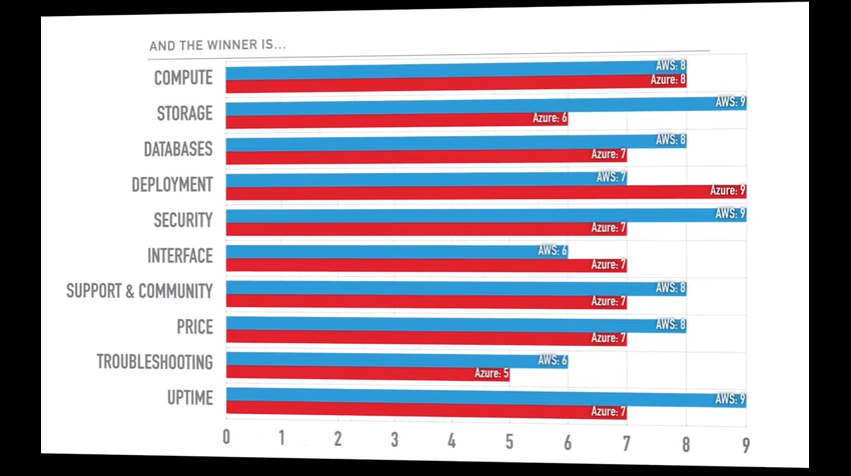
Microsoft Azure is challenging AWS as the best cloud platform. Paul Oliver has used both extensively and is ready to put them head to head. He evaluates them both using several criteria:
* Compute * Storage * Databases * Deployment * Security * User Interface * Support & Community * Price * Troubleshooting & Metrics * Uptime
During this 30-minute webinar from January 13, 2016, Jeremy Cioara, Garth Schulte, and Ben Finkel compare and contrast Amazon Web Services, Google Cloud Platform, and Microsoft Azure — three of the leading cloud platforms on the market. You'll learn what features the three share, what features help them stand out, and how they can benefit you and your organization.
For the first eight years of its life, you see, Dropbox stored billions and billions of files on behalf of those 500 million computer users. But, well, the San Francisco startup didn’t really store them on its own. Like so many other tech startups in recent years, Dropbox ran its online operation atop what is commonly called “the Amazon cloud,” a hugely popular service run by, yes, that Amazon—the world’s largest online retailer. Amazon’s cloud computing service lets anyone build and operate software without setting up their own hardware. In other words, those billions of files were stored on Amazon’s machines, rather than machines owned and operated by Dropbox.
But not anymore. Over the last two-and-a-half years, Dropbox built its own vast computer network and shifted its service onto a new breed of machines designed by its own engineers, all orchestrated by a software system built by its own programmers with a brand new programming language. Drawing on the experience of Silicon Valley veterans who erected similar technology inside Internet giants like Google and Facebook and Twitter, it has successfully moved about 90 percent of those files onto this new online empire.
According to this article on Fortune.com, although Amazon Web Services still dominates the public cloud market, Microsoft is making ground and closing the gap.
They cite a survey featuring input from 1060 cloud customers:
Overall, AWS is used by 57 percent of respondents, flat from last year. Enterprise adoption of AWS grew from 50 percent to 56 percent while adoption by smaller businesses fell slightly from 61 percent to 58 percent. Azure IaaS grows strongly from 12 percent to 17 percent adoption, while Azure PaaS grows from 9 percent to 13 percent.
According to this article in CRN, Oracle spends $5.4 billion on R&D every year and that is double our nearest competitor," Senior vice president for cloud Shawn Price said. "So not only are they not spending the requisite R&D as a percentage of total revenue, they don't have the base from which to actually evolve."
Price labelled any comments that Oracle is itself late to the cloud party as "naïve" and said it couldn't have made this shift any faster.
"If you look at our competitors, they don't have a cloud ERP offering," he said. "If you think about SAP, it has no [ERP] offering in the cloud. We are often tagged as being late to the cloud, but if you look at the performance, the scale, that's very naïve. We have 19 data centers, 70 million subscriptions, 600 million SaaS applications and we have taken all the infrastructure that our customers have bought from us and imported that to the cloud.
According to this article on CIO.com, while Microsoft currently has a significant lead over Google in the workplace productivity market, the companies' cloud-based offerings are just a small fraction of their businesses. However, both plan to invest heavily in Office 365 and Google for Work in 2016.
The article explains that only 13 percent of businesses currently use either Office 365 or Google for Work, according to new research from Gartner, which means massive opportunities for growth exist for both Microsoft and Google as more businesses switch to cloud services.
"Among public companies using cloud-based email, Microsoft is more popular with larger organizations and has more than an 80 percent share of companies using cloud email with revenue above $10 billion," says Jeffrey Mann, research vice president at Gartner. "Google's popularity is better among smaller companies, approaching a 50 percent share of companies with revenue less than $50 million."
According to this article in the Washington Post, Cloud Computing "means a huge business opportunity — and that has sparked heavy competition among companies looking to manage the tech needs of the next decade's enterprise market."
It points out that cloud revenues were a very large focus for analyst attention on recent earnings calls with Amazon, Microsoft, Google, IBM, and Oracle.
The article highlighted the fact that Amazon reported $687 million in operating income on $2.4 billion in revenue for Amazon Web Services (AWS). It also predicted that AWS revenue for the year was on track to be "just short" of $10 billion by the end of its fourth quarter. It also explained that Microsoft does not break out specifically how much money it's cloud infrastructure service, Azure, makes, but it did report that Azure had grown 140 percent in the past year. Its cloud services overall, which include traditional server businesses such as Exchange, brought in $6.3 billion in revenue in the fourth quarter, a 5 percent improvement over the same period last year.
According to this article in ETCIO, Microsoft's secret weapon to beat Amazon in the cloud is "Azure Stack, a product that lets you build your own version of the Microsoft Azure cloud on your own servers or data center."
They describe Azure Stack as a solution that for all intents and purposes works like Azure, including its efficient resource utilization and developer tools. Since it's the same set of tools and infrastructure, Neil says, it makes it simple to pick up and move an application or a swath of infrastructure and move it from an Azure Stack installation in a local data center and into the Azure public cloud.
The article summarizes the opportunity by stating that this service will be in high demand for enterprise customers to transition their on premise infrastructure to the cloud and even smaller customers might be interested in taking advantage of a service like this. It also states that Google and Amazon don't have any products in place today or in the near future that can provide the capabilities of Azure Stack.
According to this article on Marketwatch,Microsoft is gaining momentum with its Azure product line, which saw a 140% year-over-year jump in revenue in constant currency. Amazon Web Services reported $2.4 billion in sales for AWS on Thursday, with $687 million in operating income, for a revenue growth rate just shy of 70% — about half of Azure’s reported rise, though Amazon’s number did not use constant currency.
Microsoft continues to leverage it's long relationship with enterprise customers and is using it's success with Office 365 to build ties with Azure as well. Amazon still has a huge lead over Microsoft, but with double the growth it won't be long until that margin shrinks.
According to this article on The Motley Fool, Amazon is poised to dominate the $191 billion "hypergrowth" opportunity that is cloud computing by 2020. The article highlights over-hyped security concerns that supposedly keep organizations out of the cloud by mentioning the fact that Amazon Web Services (AWS) won a $600 million cloud contract for the CIA back in 2013.
This article states that Amazon is larger than it's next 4 largest competitor in Infrastructure as a Service (IAAS) although we have been seeing articles that say Amazon is bigger than their next 14 competitors.
The article is concluded by trying to estimate a value for Amazon's cloud business by comparing them to pure-play cloud providers Salesforce and Box and coming up with a value between $51.5 and $68.2 billion dollars.
According to this article on Market Realist, Microsoft Azure is projected to reach an annual run rate of $8 billion in 2016 compared to Amazon's AWS run rate of $7 billion in 2015. They are saying Microsoft will begin to catch to up to Amazon because of their long history of selling enterprise software to big companies. I tend to agree that Microsoft along with others like Oracle and IBM will continue to make inroads on Amazon's dominant market position because of their customer relationships as well as the absolutely HUGE investments each of them are pouring into this race to catch up to the leader. Although Amazon has a huge lead on each of them, these other competitors have huge cash cow businesses that will allow them to make large strides in closing the gap. Amazon will be able to rely on scale at least for the next year or two, but eventually these players will catch up and the then The Cloud Wars will really start beginning.
According to this article on CIO.com, Microsoft will beat Google in the enterprise cloud space because Office 365 is better accepted by large enterprise customers, while customers in the small business space are still happy with Google Docs for Business.
It makes sense. Microsoft had such a dominant presence with their desktop office applications with large businesses for decades. As soon as they introduced the multi device and collaboration capabilities provided with the cloud, those customers found it easier to stick with what they had been using in the past. Google is still strong with the small business market who switched to them earlier. They were most likely trying to avoid Microsoft price premiums in the first place which is why they adopted the free Google Docs service. Enterprise customers were already accustomed to paying the Microsoft fees. Trust and security issues prevented them from allowing their users to switch to the new services Google was offering. Now that Microsoft has the competitive Office 365 platform, there is no longer reason for them to consider switching.
The question is, will Google be able to introduce enough unique features to win over loyal Microsoft customers? I can't wait to see their next move.
Fortune Magazine recently published an article explaining Google's plan to compete with Amazon and others in the cloud. They say they've got their work cut out for them since last year Gartner estimates showed that Amazon Web Services is running with 10 times the capacity of it's next 14 cloud competitors combined.
They showcase how Google is building an infrastructure comparable to Akamai and is partnering with the Content Delivery Network leader to enhance both company's capabilities. They also have put former VMWare CEO in charge of their cloud unit which should help them be more competitive.
But Google has struggled to cloud services to business users mainly because they haven't had the history of selling through a channel to these kinds of accounts in the same way that Microsoft or IBM has had and without those relationships, it's an uphill battle to win the their trust. They've had to play the price game to attract new customers and that's never a winning strategy when dealing with competitors with a larger footprint or better relationship with clients.
Obviously, Google has a tremendous amount of technical know how and a very lucrative cash flow from their search and advertising businesses to fund a tremendous amount of R&D and make strategic investments to help them catch up with Amazon and Microsoft. so this battle is just beginning.
...
to create much higher-margin goods, and all three cloud providers offer a
range of additional services built on top of the commodity
infrastructure.
On Friday, Microsoft announces the general availability of incredible new capabilities in Azure. The new G Series Virtual Machines will be the most powerful VMs yet featuring up to 32 vCPUs with the latest XEON e5 v3 processors, up to 448GB of memory. and an amazing 6.59 TB of local SSD storage. All this memory will enable much faster deployments of mission critical apps including relational database servers like SQL and MySQL as well as large NoSQL and BigData solutions like MongoDB, Cassandra, Cloudera, xTremeData, and DataStax. Microsoft Azure continues to put pressure on the rest of IAAS suppliers. Your move, Amazon. Announcement Details: http://azure.microsoft.com/blog/2015/01/08/azure-is-now-bigger-faster-more-open-and-more-secure/
According to the Motley Fool, Microsoft will win the Cloud Wars.
Their premise is as follows: Because Microsoft's figured out the real opportunity to generate cloud revenues isn't hosting, that's already a commoditized business. Delivering its suite of software products via the cloud, and continuing to add solutions and delivery channels via strategic partnerships is where Microsoft CEO Satya Nadella is focusing his efforts, just as he should. It's a good point. Amazon and Google have been so quick to slash prices, you wonder how much they truly think their customers value their service. You can make the argument that Microsoft is a dinosaur and all the momentum has been with Google and Amazon, but Microsoft has played this game for a lot longer than either one of these companies. Office 365 is a winner. Microsoft still owns the enterprise back-end infrastructure and a huge percentage of the end point clients. If they can continue to provide value to their clients as well as security, manageability, and productivity, their clients will remain loyal. And these clients are used to paying big bucks for their licensing fees. They're not going to be quick to completely jump to away from them and if anything, they'll probably start to swing back towards them if Windows 10 is more Windows 7 than Windows Vista. I wouldn't bet against Microsoft.